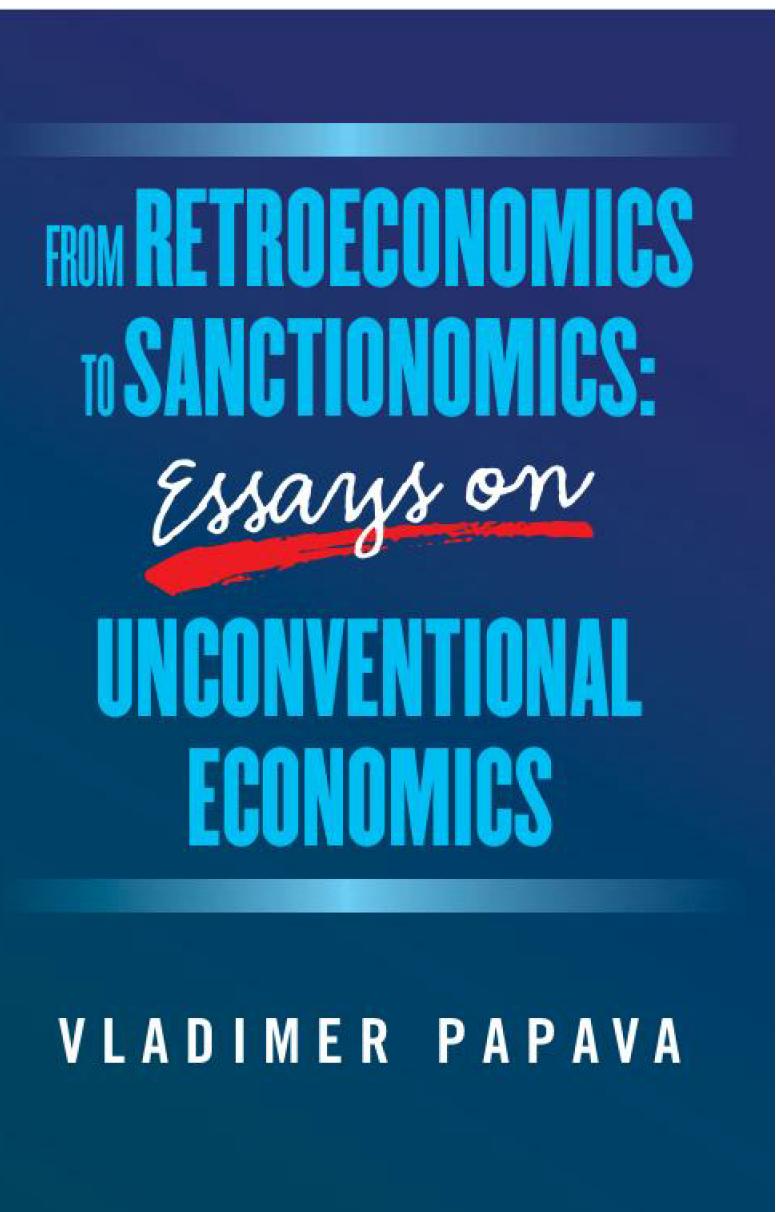
FROM RETROECONOMICS TO SANCTIONOMICS: ESSAYS ON UNCONVENTIONAL ECONOMICS
Abstract
*
References
Papava V. (1993). A New View of the Economic Ability of the Government, Egalitarian Goods and GNP. International Journal of Social Economics, 20(8): 56–62.
Papava V. (1994). The Role of the State in the Modern Economic System. Problems of Economic Transition, 37(5): 35–48.
Papava V. (1996). The Georgian economy: From ‘shock therapy’ to ‘social promotion’. Communist Economies and Economic Transformation, 8(2):251–267. DOI: 10.1080/14631379608427856
Papava V. (1999). The Georgian Economy: Main Directions and Initial Results of Reforms. In Systemic Change in Post-Communist Economies. Selected Papers from the Fifth World Congress of Central and East European Studies, Warsaw, 1995, P. G. Hare, ed. London, Macmillan Press: 266–292.
Papava V. (2000). State, Public Sector and Theoretical Prerequisites to a Model of an ‘Economy Without Taxes’. International Journal of Social Economics, 27(1–2): 45–61.
Papava V. (2001). Necroeconomics and Post-Communist Transformation of Economy. Tbilisi, Company Imperial.
Papava V. (2002). Necroeconomics—the Theory of Post-Communist Transformation of an Economy. International Journal of Social Economics, 29(10): 796–805.
Papava V. (2002). On the Laffer Effect in Post-Communist Economies (On the Bases of the Observation of Russian Literature). Problems of Economic Transition, 45(7): 63–81.
Papava V. (2003). On the Role of the International Monetary Fund in the Post-Communist Transformation of Georgia. Emerging Markets: Finance and Trade, 39(5): 5–26.
Papava V. (2003). Splendours and Miseries of the IMF in Post-Communist Georgia. Laredo, we-publish.com.
Papava V. (2004). The Doctrine of Market Equality. Questions of Theory and Its Application to the Process of Postcommunist Transformation. Problems of Economic Transition, 47(8): 6–28.
Papava V. (2005). On the Theory of Post-Communist Economic Transition to Market. International Journal of Social Economics, 29(9–10): 77–97.
Papava V. (2005). Necroeconomics. The Political Economy of Post-Communist Capitalism. New York, iUniverse.
Papava V. (2006). Economic Transition to European or Post-Communist Capitalism? EACES Working Papers, no. 1, March, <https://deliverypdf.ssrn.com/delivery.php?ID=105078117027007080018085095081085064030064049034070049097092097112064107065093123095050000006042010051053024099023025074017090019080035020033096115103092075126018073056062046025030095095066120092099021009106123093092025011079115118064099001000106020092&EXT=pdf&INDEX=TRUE>.
Papava V. (2007). Does the Market Exclude Equality? Bulletin of the Georgian National Academy of Sciences, 175(1): 204–209.
Papava V. (2008). Is Zombie Economicus Coming? Market Oracle, February 7, <https://www.marketoracle.co.uk/Article8736.html>.
Papava V. (2008). Theoretical foundations of the Laffer Curve. Bulletin of the Georgian National Academy of Sciences, 2(1): 165–168.
Papava V. (2009) Post-Communist Capitalism and the Modern World of Dead Economy. Bulletin of the Georgian National Academy of Sciences, 3(2): 198–203.
Papava V. (2009). Alternatives of the Laffer Curve with ‘hysteresis’. Bulletin of the Georgian National Academy of Sciences, 3(1): 198–200.
Papava V. (2009). The ‘Rosy’ Mistakes of the IMF and World Bank in Georgia. Problems of Economic Transition, 52(7): 44–55.
Papava V. (2009). The human factor in the Modern Financial Crisis. Bulletin of the Georgian National Academy of Sciences, 3(3): 198–204.
Papava V. (2009). The Problem of Zombification the Postcommunist Necroeconomy. Problems of Economic Transition, 53(4): 35–51.
Papava V. (2009). The Economic Development Complex in the Black Sea Area: The Impact of the Global Financial and Economic Crisis. Xenophon Paper, No. 9. Athens, ICBSS, <https://icbss.org/wp-content/uploads/2021/04/ICBSS-Xenophon-Paper-No.9-.pdf>.
Papava V. (2010). Economy of Post-Communist Capitalism Under the Financial Crisis. Studies in Economics and Finance, 27(2): 135–147.
Papava V. (2010). Post-Communist Capitalism and Financial Crisis, or the Mixing of the Necroeconomics and the Zombie-Nomics. Georgian International Journal of Science and Technology, 2(1): 37–55.
Papava V. (2010). The Economic Challenges of the Black Sea Region: The Global Financial Crisis and Energy Sector Cooperation. Southeast European and Black Sea Studies, 10(3): 361–371.
Papava V. (2011). On the first-generation post-communist reforms of Georgia’s economy (A retrospective analysis). The Caucasus & Globalization, 5(3–4):20–30.
Papava V. (2012). Economic Growth in the Central Caucaso-Asian Countries Adjusted for the Catch-Up Effect. Central Asia and The Caucasus, 13(4): 120–128.
Papava V. (2014). The Catch-Up Effect and Regional Comparisons of Growth Indicators (With the Eastern Partnership Countries as an Example). Problems of Economic Transition, 57(3): 3–12.
Papava V. (2015). Necroeconomics of Post-Soviet Post-Industrialism and the Model of Economic Development of Georgia and Russia. Journal of Business and Economics, 6(5): 976-983, <http://www.academicstar.us/UploadFile/Picture/2015-7/20157313847837.pdf>.
Papava V. (2016). The Problem of the Catch-Up Effect and Post-Crises Economic Growth in the World Leading Countries. Bulletin of the Georgian National Academy of Sciences, 10(4): 97–104.
Papava V. (2016). Technological Backwardness – Global Reality and Expected Challenges for the World’s Economy. Expert Opinion 70. Tbilisi, GFSIS, <https://gfsis.org.ge/files/library/opinion-papers/70-expert-opinion-eng.pdf>.
Papava V. (2017). On Production Factors. Bulletin of the Georgian National Academy of Sciences, 11(4): 145–149.
Papava V. (2017). Retroeconomics – Global Challenge for Economic Development. The Market Oracle, February 9, <http://www.marketoracle.co.uk/Article58104.html>.
Papava V. (2017). Retroeconomics – Moving from Dying to Brisk Economy. Journal of Reviews on Global Economics, 6: 455–462, <https://www.lifescienceglobal.com/independent-journals/journal-of-reviews-on-global-economics/volume-6/85-abstract/jrge/2929-abstract-retroeconomics-moving-from-dying-to-brisk-economy>.
Papava V. (2018). Catching Up and Catch-Up Effect: Economic Growth in Post-Communist Europe (Lessons from the European Union and the Eastern Partnership States). European Journal of Economic Studies, 7(2): 109–125, <https://ejes.cherkasgu.press/journals_n/1537557942.pdf>.
Papava V. (2018). Frontier Growth, Catching Up, Falling Behind and Extremely Falling Behind. The Market Oracle, May 22, <http://www.marketoracle.co.uk/Article62332.html>.
Papava V. (2018). The Economics in Crisis and the Main Directions for Transformation of Economic Science. Transformations, (3–4): 90–108.
Papava V. (2018). Why Georgia Needs Economists. Rondeli Blog, October 12, <https://gfsis.org.ge/blog/view/871>.
Papava V. (2018). Assessment of Economic Growth in the Post-Communist Members of the European Union and the Eastern Partnership States Expert Opinion 101. Tbilisi, GFSIS, <https://gfsis.org.ge/files/library/opinion-papers/101-expert-opinion-eng.pdf >.
Papava V. (2018). Catching Up and Falling Behind: The Experience of the Post-Communist Countries of the European Union and Georgia. Expert Opinion 99. Tbilisi, GFSIS, <https://gfsis.org.ge/files/library/opinion-papers/99-expert-opinion-eng.pdf>.
Papava V. (2019). On the Non-Economic Policy and the Post-Communist Experience of Georgia. European Journal of Economic Studies, 8(2): 143–151, <https://ejes.cherkasgu.press/journals_n/1573764064.pdf>.
Papava V. (2020). Coronomic Crisis: When the Economy is a Hostage to Medicine. Eurasia Review, March 29, <https://www.eurasiareview.com/29032020-coronomic-crisis-when-the-economy-is-a-hostage-to-medicine-oped/>.
Papava V. (2020). Features of the Economic Crisis under the COVID-19 Pandemic and the Threat of the Zombie-ing of the Economy. Bulletin of the Georgian National Academy of Sciences, 14(3): 128–134.
Papava V. (2020). Is the Vaccine a Panacea? Eurasia Review, September 30, <https://www.eurasiareview.com/30092020-is-the-vaccine-a-panacea-oped/?fbclid=IwAR0A1A6aQRGpC-6SfhcjjtneRU34HGm920joNgHsnZMIO4raEsLWO8l5Jrs>.
Papava V. (2020). Ob ekonomicheskom roste v postkommunisticheskikh stranakh Vostochnoy Yevropy [On the Economic Growth in Post-Communist Countries of Eastern Europe]. Ekonomika i matematicheskiye metody [Economics and Mathematical Methods], 56(1): 34–43.
Papava V. (2020). On the Atypical Economic Crisis Under the COVID–19 Pandemic. Economics and Business, XII(4): 9–16.
Papava V. (2021). On Pseudo De-Globalization, Silk Road of Global Value Chains and Role of Georgia. Eurasia Review, October 18, <https://www.eurasiareview.com/18102021-on-pseudo-de-globalization-silk-road-of-global-value-chains-and-role-of-georgia-oped/>.
Papava V. (2022). Cold War vs. Hot War in 2022. Eurasia Review, February 28, <https://www.eurasiareview.com/28022022-cold-war-vs-hot-war-in-2022-oped/>.
Papava V. (2022). Moving from Hyper-Globalization. Eurasia Review, October 28, <https://www.eurasiareview.com/28102022-moving-from-hyper-globalization-oped/?fbclid=IwAR2pYf4-drq_z0j5oF9mad6BO8SrjxvsRUbd7ebBjdtt6Fp14jYVZiVITq0>.
Papava V. (2022). On Illegal Globalization, or Can Globalization Ever End? Eurasia Review, December 19, <https://www.eurasiareview.com/19122022-on-illegal-globalization-or-can-globalization-ever-end-oped/>.
Papava V. (2022). On Sanctionomics and the Externalities of Economic Sanctions. Bulletin of the Georgian National Academy of Sciences, 16(2): 142–149.
Papava V. (2022). On Sanctionomics. Eurasia Review, March 14, <https://www.eurasiareview.com/14032022-on-sanctionomics-oped/>.
Papava V. (2022). The Underproduction Inflation – An Acute Challenge for the Post-Pandemic World. Eurasia Review, February 7, <https://www.eurasiareview.com/07022022-the-underproduction-inflation-an-acute-challenge-for-post-pandemic-world-oped/>.
Papava V. (2022). Main Economic Challenges of Pandexit. Tbilisi, GFSIS, <https://www.gfsis.org.ge/files/library/pdf/Main-Economic-Challenges-of-Pandexit-3191.pdf>.
Papava V. (2022e). On the Main Challenges of the Architecture Transformation of the World Economy. Eurasia Review, March 31, < https://www.eurasiareview.com/31032022-on-the-main-challenges-of-the-architecture-transformation-of-the-world-economy-oped/>.
Papava V. (2022f). Pandemic, War and Economic Sanctions: From Turbulent to Confrontational Globalization. Eurasia Review, May 23, <https://www.eurasiareview.com/23052022-pandemic-war-and-economic-sanctions-from-turbulent-to-confrontational-globalization-oped/>.
Papava V. (2023). Can High Inflation Wipe Out the Zombies in the Economy? Eurasia Review, March 8, <https://www.eurasiareview.com/08032023-can-high-inflation-wipe-out-the-zombies-in-the-economy-analysis/>.
Papava V. (2023). How Zombie Economicus Is Gradually Replacing Homo Economicus. Eurasia Review, March 16, <https://www.eurasiareview.com/16032023-how-zombie-economics-is-gradually-replacing-homo-economics-oped/>.
Papava V. (2023). Illegal Globalization Is Russia’s Main ‘Ally’ Against the West. Eurasia Review, February 9, < https://www.eurasiareview.com/09022023-illegal-globalization-is-russias-main-ally-against-the-west-oped/>.
Papava V., Charaia V. (2019). On Complex Inflation Targeting and Modified Inflation Indicators (Experience of Georgi). Finance: Theory and Practice, 23(3): 16–34, <https://financetp.fa.ru/jour/article/view/855/575>.
Papava V., Chkuaseli M. (2021). Coronomics, Financial Support for the Economy and Its Zombie-ing (In the Context of the Fifth Factor of Production). Finance: Theory and Practice, 25(5): 6–23, <https://financetp.fa.ru/jour/article/view/1319/869>.
Papava V., Khaduri N. (1997). On the Shadow Political Economy of the Post-Communist Transformation. An Institutional Analysis. Problems of Economic Transition, 40(6): 15–34.
Papava V., Maisaia V. (2023). On Economic Security under Confrontational Globalization and the Main Concepts of Geo-Economic Warfare. Bulletin of the Georgian National Academy of Sciences, 17(4): 116–120.
Papava V., Tokmazishvili M. (2007). Necroeconomic Foundations and the Development of Business in Post-Revolution Georgia. The Caucasus and Globalization, 1(3): 84–95.
Papava, V., Bagirov, S., Grigoriev, L., Paczynski, W., Salikhov, M., Tokmazishvil, M. (2009). Energy Trade and Cooperation between the EU and CIS Countries. CASE Network Reports, No. 83. Warsaw, CASE – Center for Social and Economic Research, <http://www.case-research.eu/files/?id_plik=3050>.